How do I release these persistent, automatic habits that keep weighing me down?
Mar 24, 2026 - Travel to Seoul, Hospital Examination, Review Meetings
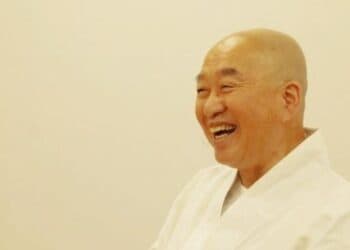
Hi. Sunim departed for Seoul early in the morning to avoid rush hour traffic. He spent the day with hospital examinations and various meetings.

Sunim left Dubuk Jungto Retreat Center at 4 AM and arrived at Seoul Seocho Dharma Center before 8 AM. After unpacking and taking a brief rest, he attended an online meeting with the Overseas Buddhist Affairs Committee at 9 AM, followed by an online meeting with the Korean Buddhist Affairs Committee at 10:30 AM.

Sunim had appointments scheduled for lung function tests and chest CT scans in the afternoon.
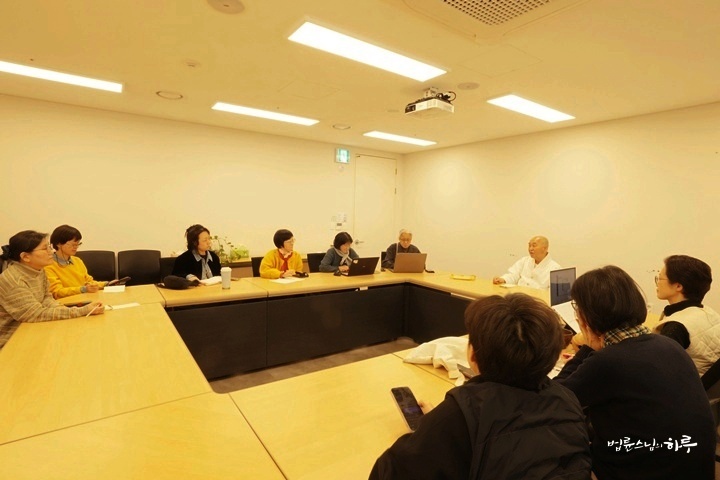
Before leaving for the hospital, he held a one-hour schedule review meeting with staff members from The Peace Foundation and JTS from 12:30 PM. JTS has been conducting a ‘Sustainable Development Project’ with the Bhutanese government under an MOU since 2024. Related Bhutanese government officials are scheduled to visit Korea from March 30 to April 4 to visit various local sites. Sunim carefully reviewed matters to discuss and preparations needed for the Bhutanese government officials’ visit program to Korea and provided his input.
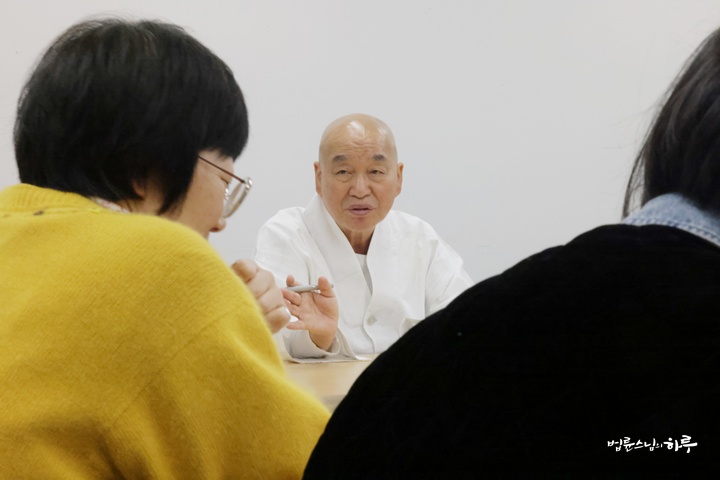
Sunim also listened to the preparation status and progress regarding the community outing schedule and course, and reviewed necessary areas. He also reviewed the progress and preparations for the religious leaders’ visit program to Sri Lanka scheduled for June and provided his input.
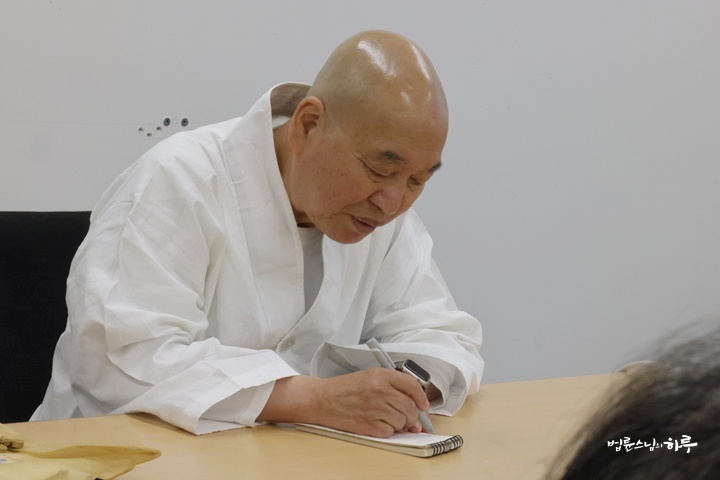
Sunim reminded staff about important matters to note while conducting departmental work and urged them to express gratitude to distinguished guests who visited after events. He also discussed with staff members about small gifts that could be given to various visitors to Jungto Social and Cultural Center.
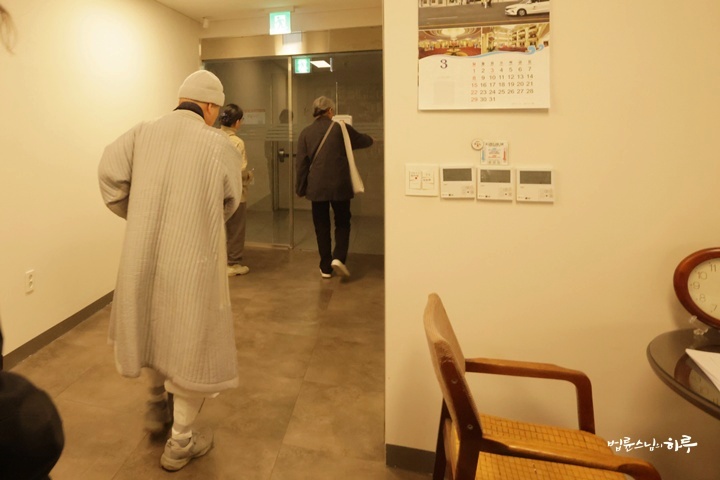
As the meeting progressed, it was time to leave for the hospital. Sunim went to the hospital for his scheduled examinations and returned to Jungto Social and Cultural Center.

At 6 PM, former Minister of Oceans and Fisheries Jeon, Jae-soo came to visit Sunim. Former Minister Jeon, Jae-soo had been invited to the 1st Youth Festa held at Jungto Social and Cultural Center last November, where he had a dialogue session with young people. After a simple dinner, they moved to the reception room to continue their conversation. Sunim took a commemorative photo and saw off his guest.
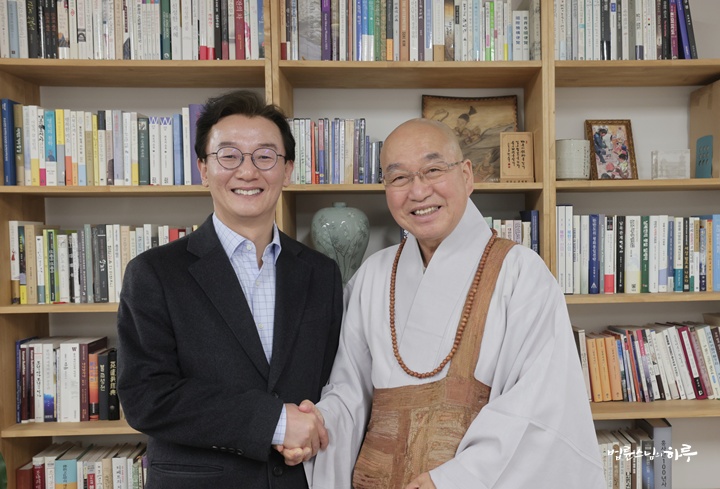
Sunim completed his day after handling various tasks.
Tomorrow, there will be a ‘Religious Leaders’ Meeting for National Reconciliation’ and Weekly Dharma Assemblies in the morning and evening. In the afternoon, he is scheduled to participate in a research seminar and planning committee meeting.
Since there was no Dharma talk today, this post concludes with a Dharma Q&A held at Jungto Social and Cultural Center in February.
How do I release these persistent, automatic habits that keep weighing me down?
“I have been pushing myself into difficult situations, believing that I can only realize something by making myself suffer. I’ve been driving myself hard. During this India pilgrimage, I exhausted myself with my greed to catch two rabbits at once – English and practice. Although I completed 10,000 prostrations before the pilgrimage, I gave up when faced with my fear of ordination. Through these processes, I now clearly know that I am someone who constantly puts myself to the test and pushes myself. The problem is that this tendency also appears in my relationships with others. During this pilgrimage, I was exhausted riding an emotional roller coaster – getting angry when seeing people who didn’t meet my standards, then quickly feeling better when misunderstandings were resolved through conversation. I know well in my head that I try to control others according to my thoughts and judge them based on my fixed ideas, but the distance between knowing this and actually feeling at peace seems too far. Also, after wandering for a long time between hatred and guilt due to my parents’ violence and verbal abuse, I’m only now barely catching my breath by keeping my distance. Despite already knowing my tendencies, how can I let go of these heavy habits that keep repeating? I would like to hear your wisdom on what mindset I should practice with to calm this turbulent mind and treat myself and others comfortably as they are.”

“Let’s say you ran 100 meters and it took 20 seconds. But you set a goal of 15 seconds. Now you need to practice consistently. But can you achieve 15 seconds within a week of practice? What about a month? What about three months? If you can’t, is it a failure?
It’s not. The important criterion is not ‘Did I reach 15 seconds?’ but whether you’ve improved even a little from your starting point of 20 seconds. For example, if after three months of practice you achieved 19 seconds, that’s a 1-second improvement. You need to look back at your starting line and have the perspective of ‘Ah, I’m improving.’ At the same time, you need to look at your goal and have the perspective of ‘I still need more practice.’
If you only look at the goal, it’s easy to feel frustrated that you haven’t reached it even after three months. Conversely, if you only look at the starting line, it’s easy to become complacent, thinking ‘I’ve reduced it by 1 second, that’s good enough.’ A practitioner must see both of these together.
A Practitioner’s Practice: Is There Change Within the Repetition?
Looking at the starting line to confirm possibility, and looking at the goal to recognize there’s still a long way to go, we must practice more diligently. We become attached, create conflicts, and then reflect. We reflect the same way yesterday and today, a year ago and now. But what’s important is whether there’s change within that. For example, if such incidents used to happen once a day, they may now have reduced to once every two days. Also, if feelings of hatred used to last all day, reflection might now occur within half a day. This is improvement.
Even though it may appear on the surface that things are ‘still not working,’ if there’s gradual improvement within, then there’s definitely potential. Conversely, if after a year things not only remain the same but have actually worsened, then you need to examine whether your method is wrong. Therefore, even though it seems like you’re repeating the same things, you need to examine whether there’s change within that repetition, or if it’s merely simple repetition. If there’s change, continue forward with that potential while contemplating whether there might be more effective methods or whether you need to increase practice time.
Gradual Change Within Repetitive Practice
Ultimately, practice may seem like simple repetition, but it’s a process where gradual changes accumulate within. When a basketball player first practices, they might not make a single shot out of ten attempts. But after a year of practice, they make five out of ten, after three years they make seven, and professionals make up to nine.
If you set a goal that all ten shots must go in, even after ten years there might still be misses. ‘You still can’t make them all?’ it becomes like this. However, the number of successful shots is gradually improving. Not all go in, and there are still failures, but the success rate is increasing. This is our life. Don’t just pass by thinking it’s the same repetition – observe more carefully. You used to get angry before, and you still get angry now, but has the frequency decreased? Has the intensity weakened? Has the recovery time shortened? You need to make efforts while observing these changes.
From what I see, you seem to be full of greed, only looking at the goal. ‘It’s not working after one year, not working after two years, why can’t I do it?’ – you’re thinking like this.”

“Sunim, people say I need to pray to look within myself, but I still feel reluctant to do so. Those around me say it’s because ‘life is still manageable for you.'”
“You could say it’s because life is still manageable, but actually, you don’t really want to change. It would be nice if things changed on their own, but you’re thinking, ‘Do I really need to make an effort to change?’ It’s like thinking, ‘It would be nice if I lost weight naturally, but do I really need to stop eating what I want just to lose weight?’ This reduces the effectiveness of improvement.
This is because karma, or habit, is something that becomes automated through repetition. When we intentionally repeat an action once, twice, three times, four times, the brain recognizes, ‘Ah, this person continues to do this,’ and it becomes automated. When something becomes automated, does it require more energy or less? It requires less. Even having an intention requires energy. When automated, it requires less energy.
However, when something becomes automated, awareness disappears. It just happens automatically. It happens without my intended awareness. We call this a ‘habit.’ That’s why we say things like ‘I did it without realizing,’ ‘I did it unconsciously,’ ‘It happened automatically.’ The key point is ‘without realizing’ – there was no awareness.
Doing something unconsciously means it was performed below the level of consciousness. Our autonomic nervous system, digestion, heartbeat – all of these are influenced by the unconscious. Consciousness cannot stop the heart. However, psychological anxiety affects all of these. The same goes for digestive function. So when you repeat the same thing or take it seriously, it influences the unconscious. But if you keep thinking ‘I should change, I should change’ while internally rationalizing ‘Oh well, how long am I going to live anyway, why bother changing that?’ no change will occur no matter how much you think about it.
So there’s no need to worry particularly. If you want to change, you need to practice with that level of intensity and duration for change to occur. If you don’t want to change, just accept the consequences. When problems arise, when you’re criticized or scolded, just say ‘I’m sorry, I have a bad temper.’ Even if you don’t get promoted at work, think ‘I should be grateful just to have a job, what promotion?’ If you live this way, it’s also manageable. It’s fine.
If you don’t want to study, you need to accept that your grades will drop. If you want to improve your grades, you have to study. Is there a way to improve grades without studying? Do you think your grades will improve just by reciting prayers? If that were the case, you should go to church. You should go to a temple known for miracles. Those places claim that even if you do bad things, you’ll go to heaven if you pray, and even if you don’t study, you’ll get into college if you pray. So you’d have no choice but to attend such places. However, the laws of nature and scientific principles don’t work that way.
“Yes, thank you.”